


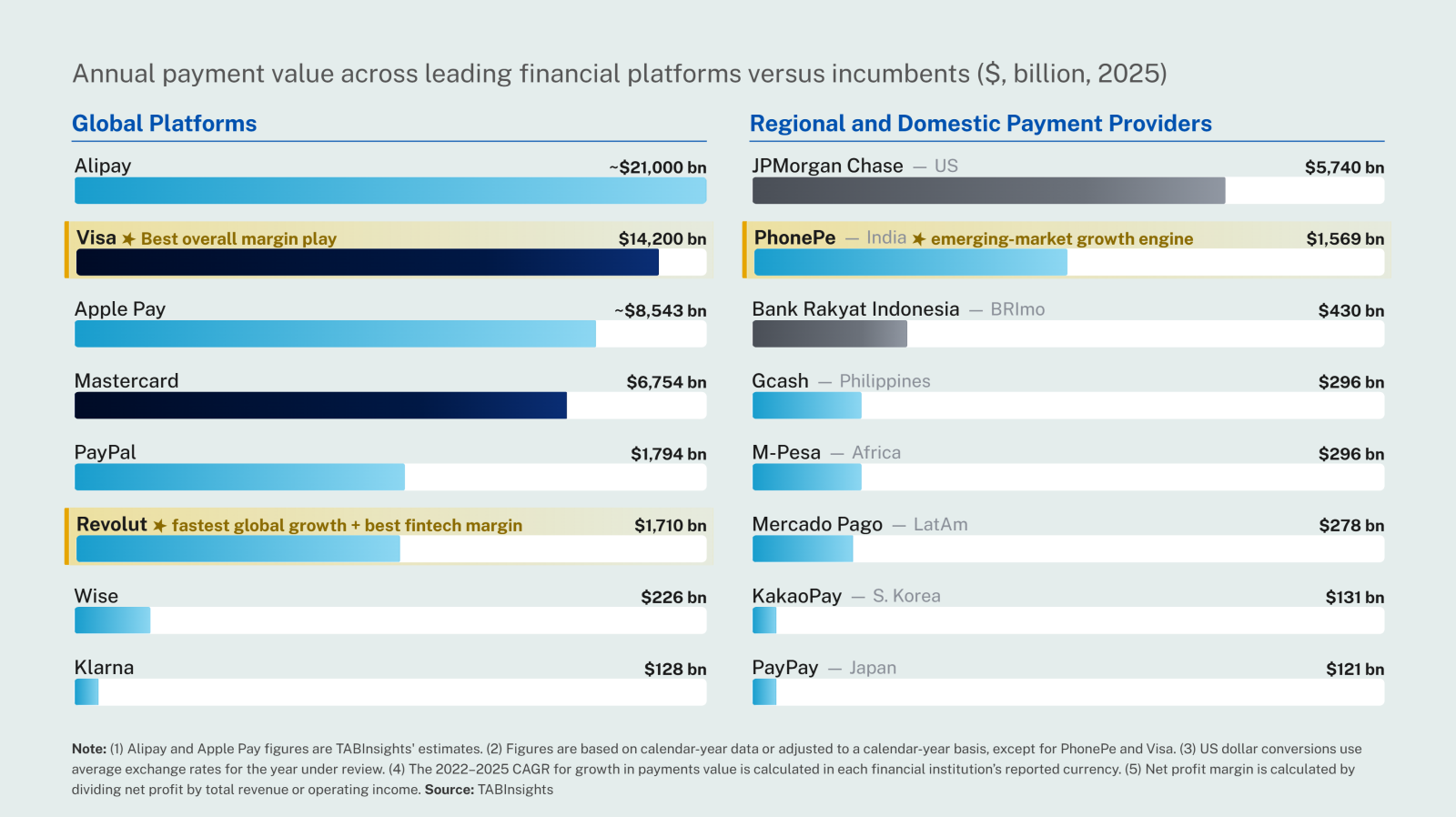

Over the past decade, fintech platforms have evolved from payment interfaces into formidable competitors to banks. By combining high-frequency payment relationships with partner-bank infrastructure and separately regulated distribution entities, they have expanded into savings, credit, insurance and investments without necessarily obtaining a full digital banking licence. The leading platforms in the World's Best Financial Platform Ranking processed more than $37 trillion in payments in 2025. At the top, Alipay handled an estimated $21 trillion, matching the combined payments value processed by Visa and Mastercard.
In most markets, the leading fintech platforms process more retail and business payment transactions than their incumbent banking rivals. Indonesia is a notable exception, where Bank Rakyat Indonesia (BRI) has outpaced GoTo, the country's largest technology super-app. Transaction value on BRI's BRImo app grew from $180 billion to $430 billion between 2022 and 2025, representing a compound annual growth rate (CAGR) of 38%, compared with GoTo Financial's gross transaction value growth from $24 billion to $40 billion, representing a CAGR of 18% over the same period.
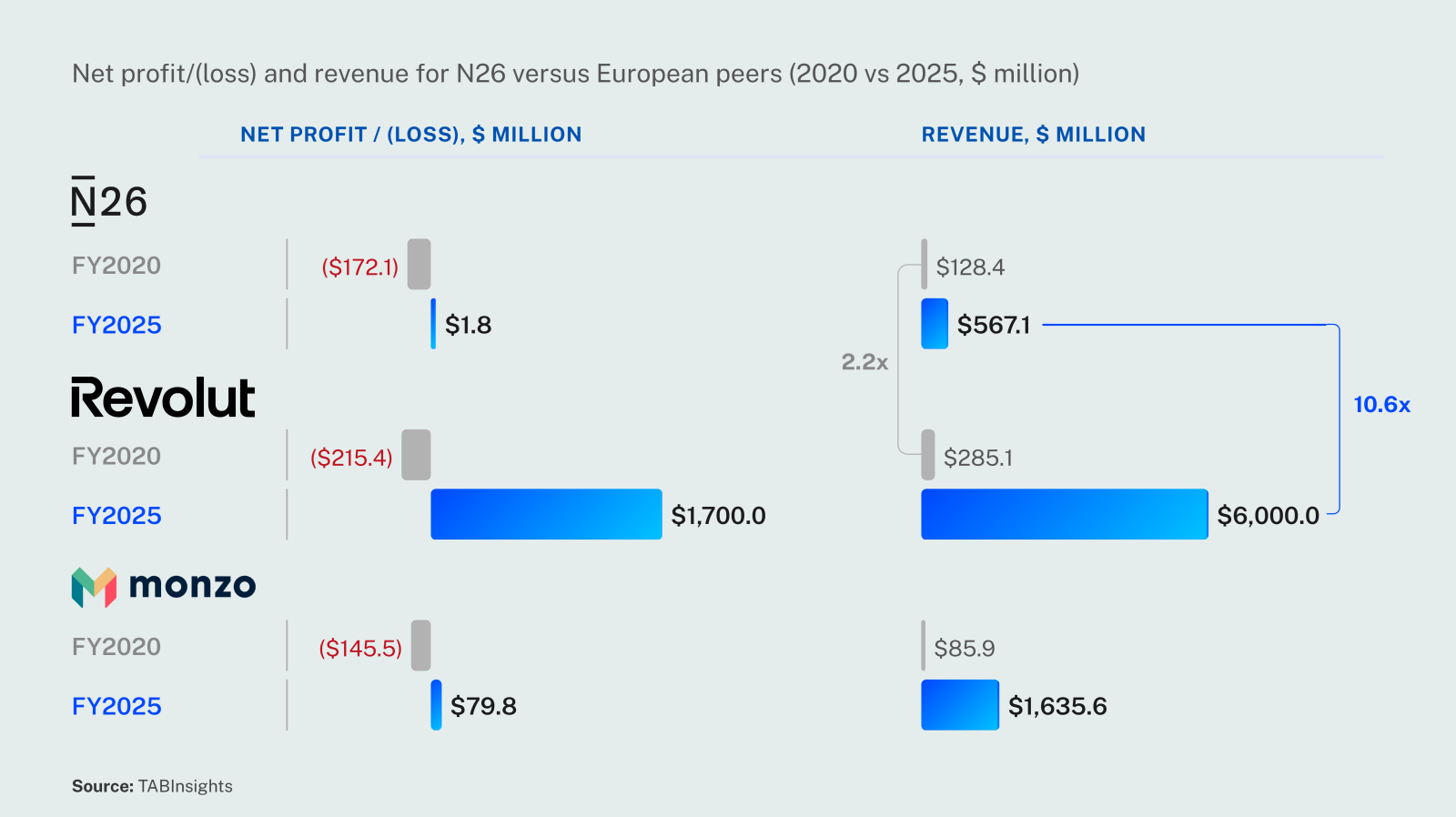
Most fintech platforms have achieved profitability at scale, although performance varies widely. Revolut paired rapid growth with a 28.9% net profit margin, while Wise and GCash each recorded margins above 20%. By contrast, Klarna and PhonePe remained loss-making. Payment scale creates a powerful distribution advantage, but sustainable profitability depends on the strength of the technology platform, the depth of customer engagement and the ability to monetise services beyond the transaction. Most of the leading fintech platforms have successfully made that transition.
Revolut leads global fintech platforms in both profit margins and payments value growth
Revolut's 28.9% net profit margin is the highest among the fintech platforms analysed (Figure 1), although it remains below Visa's 36%. The result reflects the operating leverage of a technology-led platform, with revenue rising 46% while average headcount increased just 10%. AI has been central to these productivity gains. Its chatbot resolves more than 75% of customer support interactions, while PRAGMA, a banking-specific foundation model trained on 24 billion events, provides a common AI backbone for fraud detection, credit scoring and product recommendations. Compared with task-specific models, PRAGMA improved fraud recall by 64.7% and credit-scoring performance by 130%.
Revolut's technology platform supports a diversified, high-margin revenue model. Card payments, subscriptions, wealth management and foreign exchange accounted for 66% of total revenue, while higher customer balances generated GBP 151 million ($199 million) of interest income with limited lending risk. Only 16% of interest income came from lending, with the remainder generated from cash and treasury assets. This diversified income mix enables Revolut to generate strong returns without the cost base or credit exposure of a traditional universal bank.
Transaction value increased from approximately GBP 443 billion ($548 billion) in 2022 to GBP 1.26 trillion ($1.71 trillion) in 2025, representing a CAGR of 42%, as Revolut's retail customer base expanded from more than 26 million to 68.3 million. Local accounts, domestic payment methods and banking licences encouraged customers to use Revolut for salary deposits and everyday spending, while cards, transfers, foreign exchange, savings and investments deepened engagement. Revolut Business contributed GBP 277 billion ($365 billion), or 22% of total payments value in 2025, through corporate payments, payroll, expense management and merchant acceptance. This broad product offering strengthens customer retention, increases transaction frequency and drives referrals.
PhonePe (India) stands out as one of the fastest-growing financial platforms in emerging markets
PhonePe has become India's largest payments platform, serving consumers and merchants while expanding into lending and insurance distribution. Payment value increased from approximately INR18.9 trillion ($241 billion) in fiscal year 2022 (FY2022) to INR133 trillion (USD1.569 trillion) in FY2025 ended March, a CAGR of 91%. The platform has more than 658 million registered users, including over 47 million merchants, and processes more than 440 million payment transactions daily.
PhonePe's rise reflects India's transition from the wallet era to the Unified Payments Interface (UPI) era. Paytm defined the first phase of mobile payments following demonetisation, when consumers typically loaded funds into proprietary wallets before making purchases. PhonePe, acquired by Flipkart in 2016, made an early and decisive bet on UPI, allowing users to transfer money directly between bank accounts without maintaining a stored-value balance. While integration with Flipkart and Myntra provided early distribution, its longer-term advantage came from making UPI an everyday utility through reliable bank-to-bank transfers, bill payments, recharges, online checkout and a rapidly expanding offline QR network. As UPI made digital payments interoperable, competitive advantage shifted from controlling closed wallets to providing the most reliable user experience and the broadest acceptance network. Although Paytm later embraced UPI, PhonePe had already established strong network effects across consumers and merchants.
PhonePe processed more than 45% of customer-initiated UPI transactions by volume and approximately 49% by value, well ahead of Paytm and sufficient to sustain its position as India's leading payments platform. Regulatory restrictions imposed on Paytm Payments Bank in 2024 widened the gap, but PhonePe's leadership had already been established through its early commitment to UPI and strong network effects.
Rather than relying on transaction fees from UPI, PhonePe used payments as the foundation for a broader financial services ecosystem. It initially expanded into high-frequency adjacent services such as digital gold, bill payments and recharges before adding mutual funds, insurance, lending distribution and merchant credit. The ecosystem continues to expand through Share.Market, its stockbroking and mutual fund distribution platform, and Indus AppStore, a mobile app marketplace.
The model is largely capital-light. Banks and non-bank financial companies (NBFCs) provide the loans, insurers underwrite the policies and asset managers manufacture the investment products, while PhonePe focuses on customer acquisition, data-driven targeting, digital onboarding, servicing and collections through separately licensed broking and distribution entities. This enables consumers making payments to be offered insurance or investment products, while merchants with established payment flows can be offered working capital loans based on their transaction history.
Majority owned by Walmart, which holds a stake of nearly 72%, PhonePe received regulatory approval from the Securities and Exchange Board of India (SEBI) for an initial public offering (IPO) in January 2026. The listing was postponed in March after the Iran war unsettled global financial markets. Chief executive Sameer Nigam said the company "remains committed to a public listing in India" and will proceed once market conditions stabilise.
Nigam's strategy is to progressively monetise PhonePe's vast distribution network. Merchant payments increased from less than 15% of operating revenue in FY2022 to 28% in FY2025, while lending and insurance distribution grew from less than 1% to 7.8%. Diversification is critical because most bank account-based UPI transactions carry zero merchant discount rates (MDR), even as PhonePe incurred INR 16.9 billion ($194 million) in processing costs in FY2025, representing 18% of total expenses.
The platform generates most of its revenue from consumer payment processing and platform fees. It also earns transaction processing fees from partner banks for person-to-person transfers and other financial services.
PhonePe reported a consolidated loss of INR17.3 billion ($199 million) on total income of INR 76.3 billion ($875 million) in FY2025 ended March. Excluding INR 23.6 billion ($271 million) in employee share-based compensation, it generated adjusted earnings before interest, taxes, depreciation and amortisation (EBITDA) of INR 14.8 billion ($170 million), an operating margin of 20.8%, and adjusted profit after tax of INR 6.3 billion ($72 million).
Achieving sustained profitability will depend on expanding higher-margin revenue from financial services distribution, merchant solutions and payment gateway services faster than operating costs, share-based compensation and investment in new platforms.
The next phase of competition will be defined by who can turn payments into enduring customer relationships
Revolut demonstrates the earnings potential of a unified technology platform that layers subscriptions, foreign exchange, wealth management, business services and interest income onto a rapidly expanding customer base. PhonePe illustrates the emerging-market equivalent, using its near-ubiquitous payments network to distribute merchant services, lending, insurance and investments despite the limited monetisation of the underlying UPI rail. Its rise over Paytm also shows how quickly market leadership can shift when new payment infrastructure changes the basis of competition. While established card networks will remain formidable because of their scale and profitability, the next generation of financial leaders will be those that combine the growth of software platforms with the trust, breadth and economics of banks without inheriting their operating complexity.







.png)
.webp)








 Google
  LinkedIn