


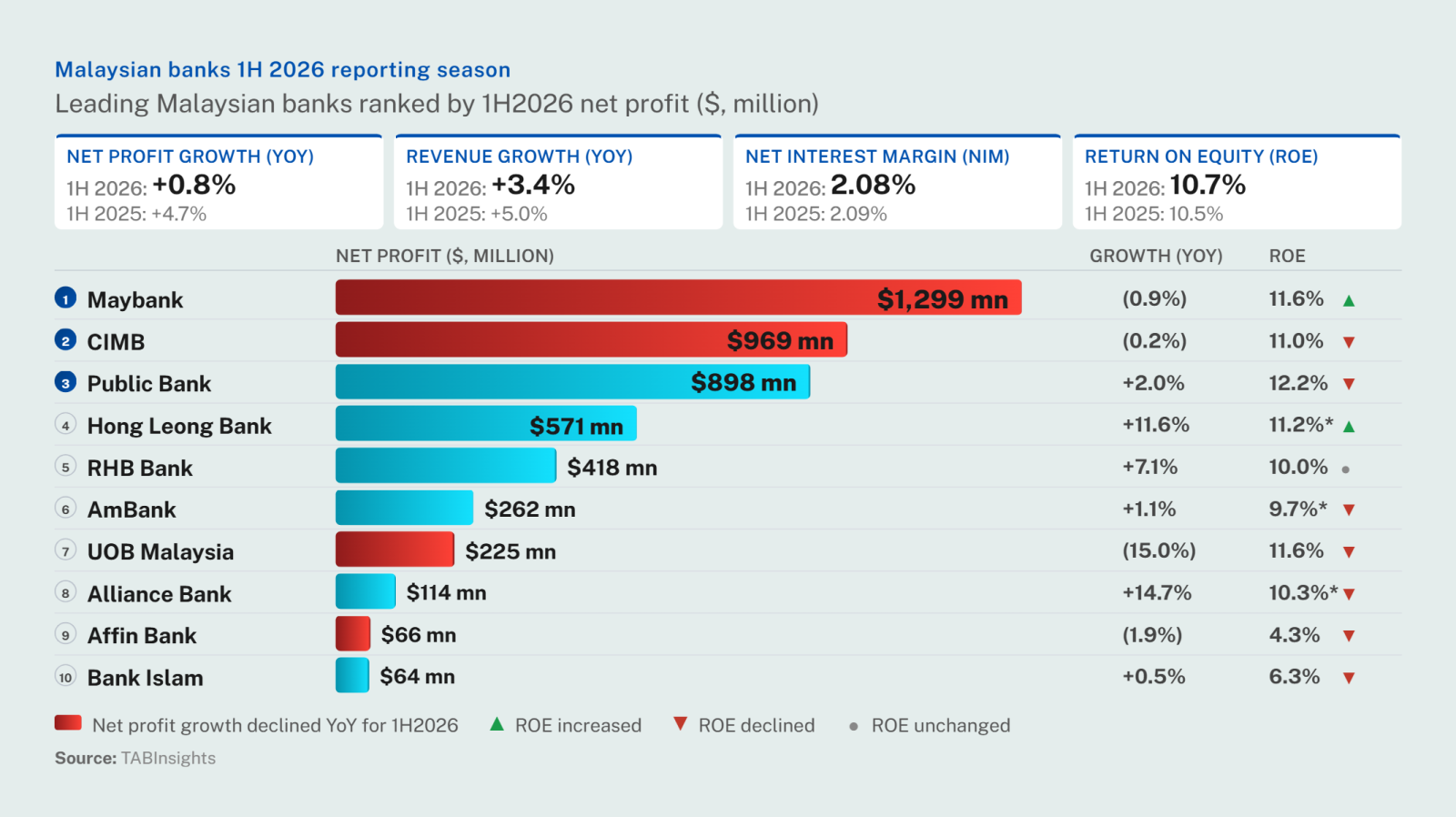

Malaysia's 10 largest banking groups delivered a mixed first half. Median revenue rose 3.4% year on year (YOY), down from 5.0% growth in 1H2025, while median net profit increased only 0.8%, compared with 4.7% a year earlier. Weaker core banking growth, margin pressure and slightly higher net impairment charges offset gains from other businesses.
The first half 2026 was therefore neither a bad semester for Malaysian banks nor a strong one. Six banks used the word 'resilient' 48 times in their disclosures, led by Maybank (12) and CIMB (11). The description reflects banks managing through a tougher earnings environment rather than generating stronger underlying growth. Profitability now depends more on controlling funding costs, protecting deposit relationships and expanding higher-value businesses.
Revenue growth did not translate into stronger profit
Eight of the 10 banks increased revenue. Affin Bank led with 12.2% growth, followed by Hong Leong Bank at 8.0%, Bank Islam Malaysia at 5.1%, Alliance Bank at 3.9% and RHB at 3.7%. Yet combined revenue rose only 0.2% because Maybank's revenue fell 5.1% and CIMB's declined 1.2%.
Business activity remained healthy, but converting it into profit became more difficult. Revenue gains often failed to offset pressure from margins, funding costs and operating expenses, increasing the need for productivity and efficiency gains.
Domestic operations exposed weakness at Maybank and CIMB
Operating profit before tax fell 2.8% in Maybank's Malaysian business, compared with 2.4% for the group. CIMB Malaysia declined 0.9%, against a 2.2% group decline. Maybank's Malaysian revenue fell 8.3%, while overseas revenue grew 1.8%.
Regional operations partly offset domestic weakness. In local currencies, Maybank's pre-tax profit rose 5.4% in Singapore and 22% in Indonesia. Rupiah depreciation, however, turned the Indonesian gain into a 71% decline in ringgit terms. CIMB's pre-tax profit increased 19% in Singapore and 37% in Thailand. Indonesia fell 2.4% in local currency and 15% in ringgit terms, compared with a 0.9% contraction in Malaysia.
The weakness was therefore not a broad regional slowdown. It was more closely tied to domestic margins, deposit competition and the changing economics of Malaysian banking.
Treasury markets and wealth fees drove profit growth
Treasury and markets income rose at several banks, while wealth and fund-management fees also provided support. These earnings helped compensate for weaker lending profit, although markets income is more volatile and less predictable.
Median pre-tax profit in consumer banking slipped 0.4%, with five banks reporting declines. Maybank, AmBank and Alliance Bank were exceptions, posting growth of 38%, 67% and 23%, respectively. Maybank's gain was probably driven by overseas operations, while AmBank grew from a low base.
Corporate banking profit was probably flat across the six largest banks, although disclosure is not fully comparable. Public Bank's pre-tax profit from corporate lending fell 14%. RHB's combined corporate, commercial and SME profit declined 3%, while CIMB's corporate banking profit was broadly flat at -0.5%. Hong Leong Bank and Alliance Bank stood out, with business and corporate banking profit, including SME, rose 13.6% and 25%, respectively.
Outside core banking, treasury, markets, wealth and fund management did the most to lift group results. Median pre-tax profit growth in treasury and markets exceeded 20% across CIMB, Public Bank, Alliance Bank and Hong Leong Bank.
Core banking did not weaken everywhere. Hong Leong Bank recorded clear growth, but across the sector, treasury and fee income contributed more to the improvement than lending.
Wealth fees supported earnings but their durability remains uncertain
Among the six largest local banking groups, only Maybank and CIMB reported lower overall net fee income. RHB and Hong Leong Bank delivered the strongest growth across most fee categories, with unit trusts and other investment products providing the main growth engine. Maybank's wealth-management and investment-banking fees rose 48% and 43%, respectively, while fees from everyday banking services fell 11%.
The quality of fee growth matters as much as its pace. Public Bank's disclosure provides the clearest example. Of the MYR 170 million ($43 million) increase in unit-trust gross fee income, more than half came from sales-related fees. This portion could weaken if investment-product sales slow.
Other banks do not provide the same level of detail, but unit-trust income is a major component of wealth-related fees across the sector. Public Bank's results show that much of the current uplift may be transactional rather than recurring.
The longer-term trend also warrants caution. Among 12 large Malaysian banks, median fee and commission income fell from 10.3% of revenue in 2022 to 10.2% in 2024 and 9.5% in 2025, according to The World’s 1000 Largest Banks Ranking
Bad loan ratios remained low but write offs eased some pressure
The banking system's gross impaired loan (GIL) ratio held at about 1.4% in June 2026, unchanged from a year earlier. Loan-loss coverage remained above 100%, according to Bank Negara Malaysia, leaving the sector with substantial buffers.
System-wide gross impaired loans rose 6.2%, mainly because of Islamic banks. Among commercial banks, excluding Islamic and investment banks, impaired loans fell 1.6%, provisions declined 11% and stage-two arrears fell 9%.
Reported stability partly reflected write-offs. CIMB's GIL ratio reached a record low of 1.64% after it wrote off MYR 1.66 billion ($417 million) of loans, while reported impaired loans fell only MYR 264 million ($66 million). Including the write-offs, the ratio would have been 2.0%.
Pressure remained visible at individual banks. Impaired loans grew faster than loan books at four of the six largest groups: Hong Leong Bank, Public Bank, RHB and Maybank. Only CIMB and AmBank reduced impaired loans.
Average credit cost at the six largest banks eased slightly, from 17.9 to 17.6 basis points. Deterioration was limited to a few areas, but unsecured retail and corporate lending require closer attention in the second half of 2026 (2H2026).
Funding costs remained the central challenge
Commercial-bank net interest margins (NIMs) have avoided a steep fall, but the longer trend points to gradual erosion. Average NIM rose from 2.3% in 2020 to 2.5% in 2021 and 2022, before falling to 2.1% in 2023, 2.2% in 2024 and 2.1% in 2025.
The sample's median NIM was broadly stable at 2.08% in 1H2026, against 2.09% a year earlier. Only three of the 10 banks avoided compression or improved margins: Maybank, up 10 basis points, Affin Bank and RHB.
Banks can defend margins through loan repricing, portfolio changes and asset allocation. AmBank, Public Bank and Hong Leong Bank shifted emphasis from mortgages towards higher-margin SME and hire-purchase lending. This suggests that stable margins were actively managed through asset mix rather than improving on their own.
Rising deposit costs are harder to address. Banks need strong customer deposit franchises, especially low-cost transactional deposits, and these take years to build.
Funding competition intensified, increasing wholesale costs and market-based funding at some banks. The main earnings pressure is therefore shifting from credit quality to funding. Customer deposits still provide more than 80% of funding for most commercial banks.
Maybank illustrates the emerging funding gap. Deposits increased MYR 4.4 billion ($1.09 billion) in the first half, while loan growth absorbed MYR 11.9 billion ($2.94 billion) in cashflows requiring additional borrowing. TABInsights estimates that group-level wholesale funding increased from December 2025 to June 2026 at AmBank by 29%, Public Bank by 18%, Maybank by 17% (6.5% at bank level), RHB by 4% and CIMB by 1.6%. It fell 16% at Hong Leong Bank. The estimate includes interbank deposits and placements, repurchase agreements, Cagamas recourse obligations, borrowings, term funding and senior debt securities.
Banks struggled to unlock operating leverage
The typical Malaysian bank spent 45% of revenue on operating costs, unchanged from a year earlier. Only five of the 10 banks achieved positive operating leverage, where revenue grew faster than expenses. They included RHB, Hong Leong Bank, Public Bank, UOB Malaysia and Affin Bank.
Cost strategies differed. Hong Leong Bank's expenses rose 7.4%, led by personnel costs and marketing. Maybank cut total costs by 3.9%, but its technology-related spending rose 13%. It invested about MYR 200 million ($49.4 million) in technology, with 40% allocated to transformation. Its core banking overhaul starts in 2027 and aims to deliver a modular, cloud-ready core by 2030, with expected annual savings of MYR 450 million ($111.3 million).
CIMB and Hong Leong reduced reported technology spending. CIMB said underlying costs were broadly stable after one-off project write-backs and kept technology spending near 7.8% of revenue.
Efficiency has improved little since 2020. The median cost-to-income ratio among the 10 largest banks rose from 44% in 2020 to 47% in 2023 and 49% in 1H2026, although it improved slightly year on year. Across 485 banks in 24 core Asia-Pacific markets, the median ratio fell from 48% in 2020 to 47% in 2023 and 46% in 2025.
Funding pressures replace asset quality as the key challenge
Malaysian banks entered 2H2026 with strong capital and broadly stable asset quality. The sector avoided a major earnings downturn, but its sources of resilience changed. Treasury and wealth-related fees supported profit while core lending earnings weakened. Funding costs now pose a greater challenge than credit quality.
The banks best-positioned for this environment will combine lending capability with strong deposit franchises and more durable, recurring income. Hong Leong Bank and Alliance Bank began the second half with the broadest operating momentum.
The next test is whether banks can sustain earnings as funding becomes more expensive and non-lending income remains less predictable. Across the sector, the ability to protect margins and sustain core banking earnings will determine how resilient profits remain.
For further insights, see The Asian Banker in-depth coverage of individual banks:
Can Maybank sustain fee and funding gains as credit costs normalise?
Can CIMB’s wholesale expansion lift underlying earnings?
Subscribe for regular insights.


Banner.png)



.png)







 Google
  LinkedIn