



Hong Kong has entered a new growth phase since 2025 by leveraging the structural advantages that have long defined its role in Asia: a trusted legal framework, deep capital markets, US-dollar-linked stability, proximity to mainland China and its position as an offshore gateway to a rising economic power. The opportunity is substantial but monetising it will require discipline. Banks aim to capture mainland-linked capital flows without underestimating the political, regulatory and reputational constraints attached to them.
The growth backdrop has already shifted decisively in favour of Hong Kong. After trailing Singapore through 2024, Hong Kong’s banking sector turned the tables in 2025, with aggregate revenue rising 11%—the strongest performance among Asia’s mature financial markets—versus roughly 1% in Singapore. A further 6-7% increase is expected in 2026, compared with about 3% in Singapore. New-resident inflows, mainland wealth, offshore investment demand and regionalising customers are expanding Hong Kong banks’ earnings opportunities. Property repricing, revived capital markets and supportive wealth and Hong Kong Interbank Offered Rate (HIBOR) conditions are adding to this momentum, which continued in 1H2026.
Operationally, banking in Hong Kong converges around four elements comprising wealth-led, mobile-enabled, AI-assisted and cross-border-oriented services. Earnings from everyday banking and payments have matured, but the territory's role as a Greater China wealth and financing hub creates room for banks that can connect deposits, transactions, lending and advice. The winning model pairs digital convenience with human advice, safer onboarding and data-driven services for affluent, family, Greater Bay Area and SME clients. The 1H2026 results show that this is increasingly reflected in banks’ income statement.
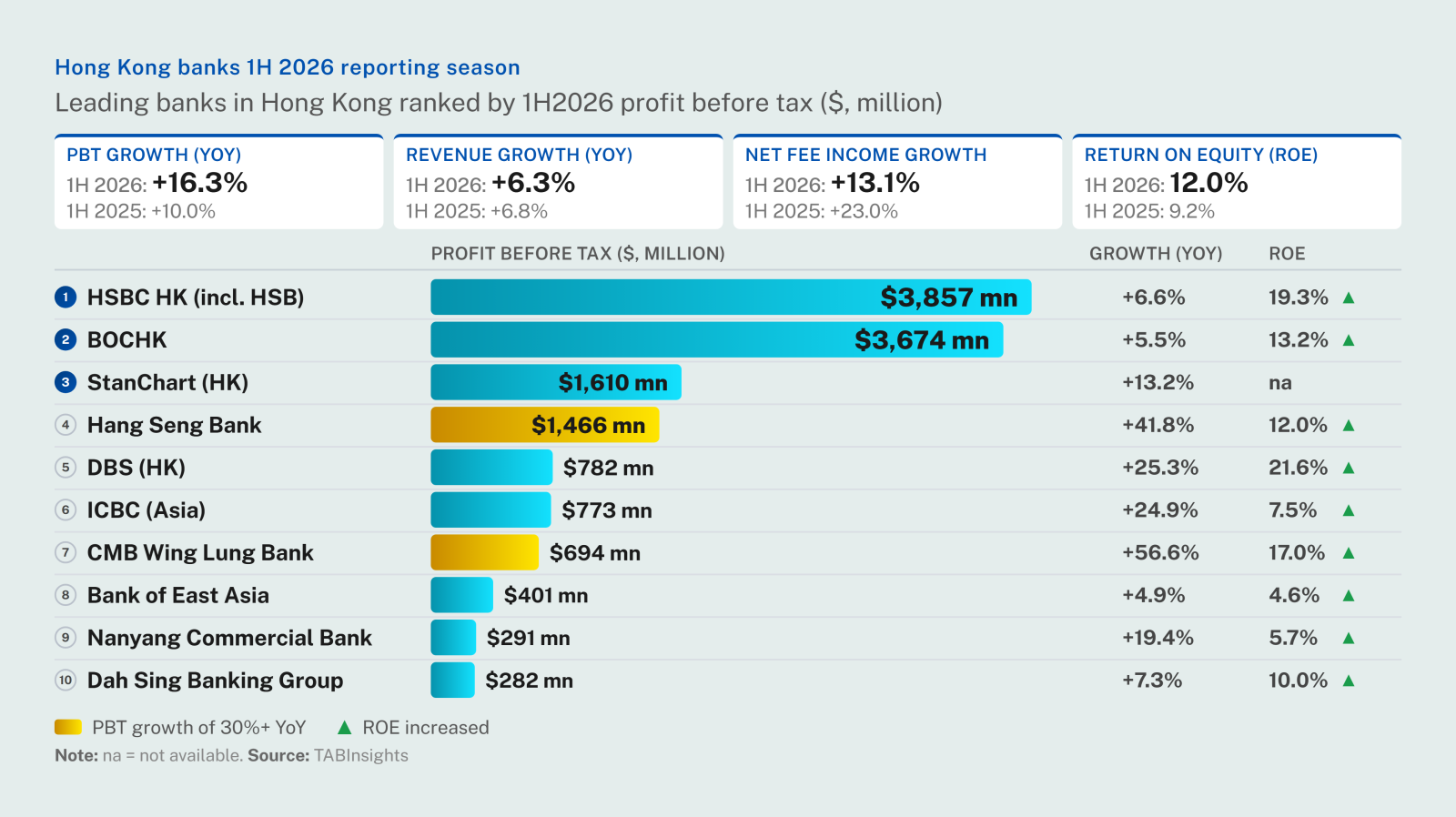
The profit headline was strong but concentrated among ten banks. The median bank grew profit before tax 16.3%. HSBC Hong Kong and Bank of China (Hong Kong) (BOCHK) generated 54% of the profit pool. Scale still matters even as the source of growth changes to fee income.
HSBC Hong Kong was the principal winner in 1H2026 among large scale banks with return on equity (ROE) of 19.3% with 6.6% profit growth and 7.1% revenue growth. Net fee and commission income growth 13.1% with overall fee income contributing 21% to overall revenue. This was against a year-on-year (YOY) loan growth of 2.2% in 1H2026. The bank’s wealth balances rose 10% YOY to $500 billion, while management reported strong deposit inflows and rising demand from trade and institutional clients. The bank also added 640,000 retail and 24,000 business-banking customers in Hong Kong driven by its breadth of the relationship, with cross-border wealth, transaction banking and financing feeding the same deposit and data franchise.
The same wealth and client flow-based revenue models were also visible in other banks. Standard Chartered Hong Kong (StanChart (HK) ) increased revenue 7.0% and profit 13.2%, with affluent-client revenue up 28% and cross-border corporate and investment banking revenue up 16%. At BOCHK, assets under management (AUM) grew over 10%. Bank of East Asia’s (BEA's) investment-sales income rose 23%, digital revenue increased 32% and discretionary portfolio assets more than doubled. In wealth management, BEA’s new private-banking customers increased 40%, with affluent Chinese clients contributing more than half of the growth. Dah Sing's net fee income rose 29%, driven by insurance distribution and retail wealth.
Most banks have expanded their private banking centres (PBCs) in the last years. BOCHK, StanChart (HK) and HSBC grew its PBCs to 11, 7 and 5 respectively as of 1H2026. Citibank, Standard Chartered and HSBC HK derive around 18-21% of revenue from wealth with GBA integration creating the most clearly defined near-term growth opportunity. Hong Kong became the world's largest cross-border wealth hub in 2025, with total assets under management from mainland China projected to further rise from about 60% to 68% by 2030, according to the Hong Kong Association of Banks.
However, a large wealth franchise does not necessarily translate into an overall stronger fee momentum. Bank of China’s personal-banking wealth income rose 14%, investment-product distribution income increased 50% and private-wealth customers grew 11%. Yet group net fee income declined 5.8%, as weaker investment, insurance and custody related fees offset gains in funds and credit cards.
Banks are also strengthening cross-border business and regional ties. BOCHK expanded its presence across Stock, Bond, Swap, Wealth Management and Payment Connect, while launching treasury and global-account solutions with BOC Guangdong and the wider BOC network. It also has developed a Southeast Asia-related businesses segment, with customer deposits rose 4.0% year to date and customer loans 9.6%. At the same time, it is deepening its RMB and offshore-market moat by becoming the world’s first offshore e-CNY custodian bank. BOCHK is also monetising its ‘super-connector’ role through funding infrastructure, not just lending. It increased the number of corporate cash pools by 14% and accumulated more than HKD 150 billion ($19.1 billion) of deposits through initial public offering (IPO) receiving-bank services, showing how capital-markets activity is feeding the deposit franchise.
Industry domestic loan growth, which turned positive in early 2025 after two years of decline, grew by 6% YOY in 1H2026 and was driven mainly by manufacturing, trade and cross-border financing, rather than reflecting broad-based retail borrowing. HSBC and Standard Chartered benefited from trade and institutional and cross-border clients. BOCHK’s strongest contributor was trade financing (+20.8%) against an industry sector average of 16%.
Real estate credit risk remains the main constraint on this transition, affecting both residential and commercial real estate (CRE). Residential and property-related industry loans continued to decline, falling 13% and 6% year-on-year as of July 2026 respectively, according to the Hong Kong Monetary Authority (HKMA). BEA was the only bank to explicitly link impairment pressure to CRE, reporting an overall 16.5% increase in impairment charges. HSBC recognised another charge related to Hong Kong commercial property, although it did not disclose the amount.
The broader concern is that CRE weakness could become self-reinforcing rather than remain contained within property lending. Commercial property prices have fallen sharply from their peaks, reducing the collateral value available to landlords and businesses and making refinancing more difficult. Banks have responded with reducing their exposure and tighter underwriting standards, with lending decisions increasingly focused on borrowers’ repayment capacity, liquidity and rental cash flow rather than asset values alone.
Overall, credit costs improved most at BOCHK, Hang Seng. Net impairment allowances fell 26.9% YOY with annualised credit cost improving from 0.39% to 0.27% driven mainly by stage 1 and 2 improvements. Hang Seng Bank’s impairment charges fell by 52% YOY, helping drive its earnings recovery. Average impaired loan ratio in the industry fell from 2.01% to 1.82%, according to BOCHK and banks expect full-year credit cost to decline further if property markets remain stable.
The second-half performance will therefore be decided by whether banks can sustain wealth and cross-border flows while keeping property-related credit costs contained. Although renewed interest-rate pressures could weigh on property transactions and prices. Nevertheless, rate volatility and tighter scrutiny of mainland outbound capital add execution risk, making compliant onboarding, diversified fee income and selective lending central to sustainable returns.


Banner.png)


.png)







 Google
  LinkedIn