


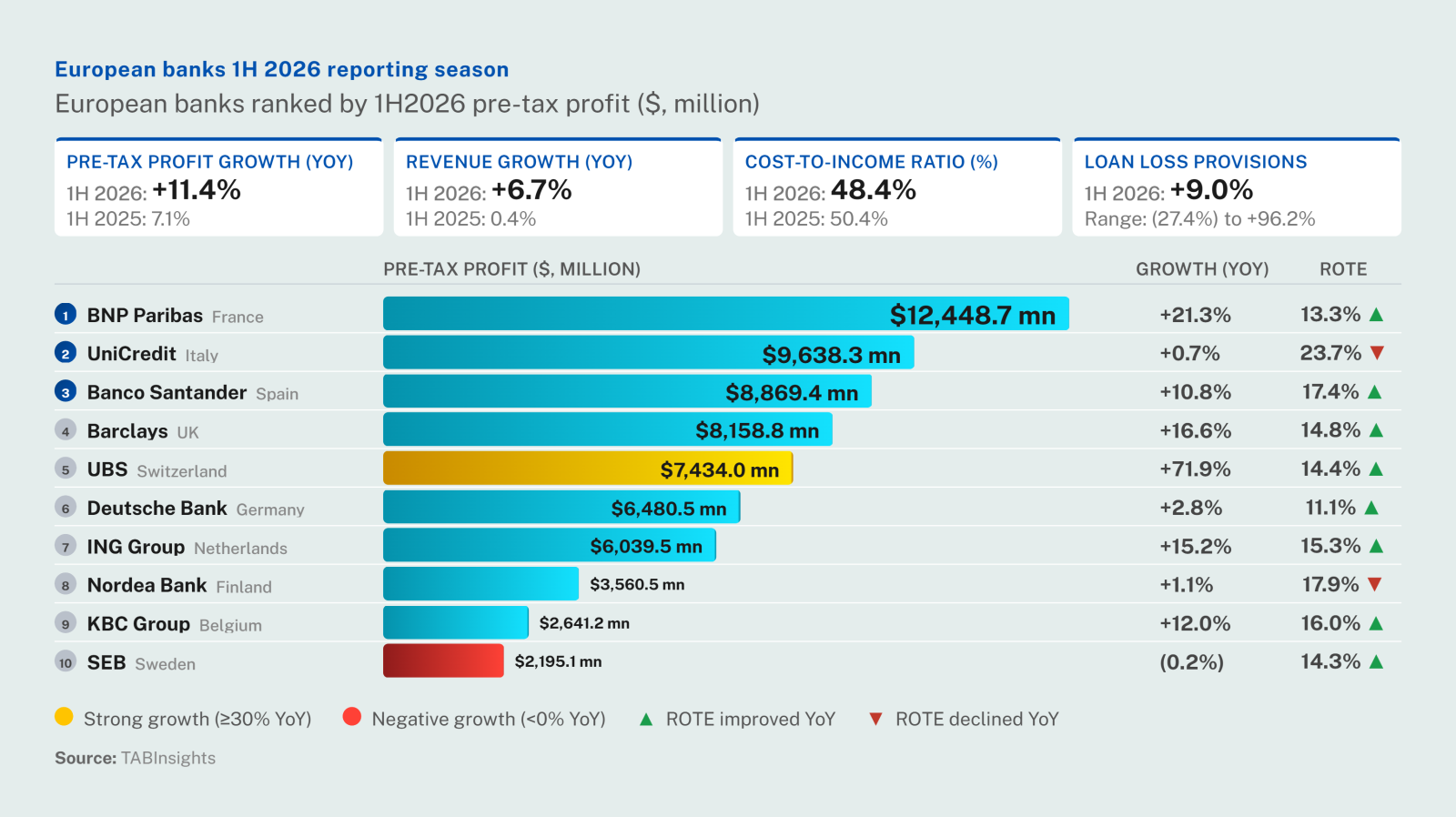

While energy and geopolitical risks continued to cloud the outlook, European banks entered the first half of 2026 (1H2026) with stronger financial performance compared with the same period in 2025. The ten-bank median revenue growth accelerated to 6.7% in 1H2026 from 0.4% a year earlier. Growth was broad-based and powered by three revenue engines: retail, business and SME banking; fees, wealth and insurance; and corporate and investment banking.
The retail and wealth side recorded the strongest revenue growth at three banks: BNP Paribas, ING and UniCredit. For SEB Bank in Sweden, all major segments declined, although retail and wealth proved the more resilient. Corporate and investment banking led at Nordea, Santander and UBS, and to a lesser extent Deutsche Bank (investment banking only), while Barclays delivered balanced growth across its businesses. KBC Group (Belgium) does not report by business lines but revenue growth was broad-based, supported by stronger lending activity across customer segments. Overall, retail banking broadened the momentum, although corporate and investment banking produced some of the largest absolute revenue gains.
Return on tangible equity (RoTE) rose for the sample to 15.1% from 13.8%, while the cost-to-income ratio improved to 48.4% from 50.4%. Except for SEB Bank and Deutsche Bank, all banks in the ranking reported stronger revenue and pre-tax profit. Deutsche Bank’s revenue increased 5%, slightly below the peer-group median, as declining corporate banking revenue partly offset strong growth in other businesses. The bank attributed this to interest-rate and foreign-exchange headwinds. The sample did not show an excessive rise in provisions; median provisions rose 9.0% in 1H2026.
Steady interest rates and resilient customer demand in 1H2026 continued to support consumer, business and corporate banking performance across the Eurozone. In contrast, Nordic banks, including those in Sweden, Norway and Denmark, reported weaker results as cautious household demand and easing of net interest margins (NIMs) weighed on earnings momentum.
Exceptional items boosted reported earnings
Transaction and exceptional gains lifted earnings in Santander, Barclays and BNP Paribas, while an accounting adjustment supported Deutsche Bank; restructuring weighed on Nordea’s earnings.
One-off gains accounted for 39.7% of BNP Paribas’s profit increase, while Deutsche Bank’s 8.8% profit growth fell to 2.8% without a EUR 310 million ($358.3 million) adjustment under International Accounting Standard 39. Santander’s statutory attributable-profit grew 31.3%, boosted by a EUR 1.90 billion ($2.20 billion) capital gain from the disposal of its 49% stake in a Polish bank. Excluding the one-off gain, the bank reported underlying pre-tax profit growth of 10.8%. In contrast, a EUR 190 million ($220 million) restructuring charge at Nordea turned 1.1% comparable growth into a 4.8% decline.
UBS, Barclays and BNP Paribas led revenue and pre-tax profit growth
UBS’s pre-tax profit increased 72% to $7.4 billion in 1H2026. Underlying pre-tax profit, which excludes integration and acquisition-related effects, increased by a still-strong 50%. Global Wealth Management and the Investment Bank generated 36% and 35% of the increase respectively. Expenses rose just 1.2%, while credit-loss expense declined. Key challenges included the final integration of Credit Suisse, Swiss capital requirements, geopolitical uncertainty and legacy legal exposure. Integration spending is expected to reach $15 billion in 2026. UBS held $1.96 billion in litigation and regulatory provisions, with up to $1.5 billion in additional possible losses.
Barclays’ group pre-tax profit rose 17% year on year, led by its US Consumer Bank and Investment Bank, which together generated 55% of group profit. Revenue growth was driven by markets and investment banking fees, structural hedge revenue and the sale of American Airlines card portfolio. Building on this momentum, Barclays raised its 2026 targets, aiming for approximately GBP 31.5 billion ($42.4 billion) in revenue, around 8% above 2025 levels, and RoTE above 12%. BNP Paribas delivered first-half revenue growth of 10.2% and a 21.3% increase in group pre-tax profit, although a EUR 744 million ($ 868 million) improvement in exceptional items accounted for 40% of the profit increase. Revenue still grew 9.2% at constant scope and exchange rates, demonstrating broad-based organic momentum. Analysts questioned the durability of this performance given trading and interest rate tailwinds, one-off gains, weak margins in Italy, delayed savings and uncertainty over distribution. The bank maintained its 2026 targets, including a 12% RoTE and cost of risk below 40 basis points (bp) unless geopolitical tensions intensify.
UniCredit led on operating efficiency and absolute returns, while Santander combined strong reported growth with improving efficiency and ING produced the most organic profit increase. ING increased pre-tax profit 15.2%, driven by a 22.5% rise in retail banking profit and a 13.4% increase in fees. Leadership was therefore defined by profit conversion, efficiency and returns rather than headline growth alone.
European markets emerge as engines of growth
European growth was strongest where recovering volumes and cost control reinforced each other. Spain produced the strongest domestic operating leverage, while the Netherlands, Belgium and Germany showed broad-based progress across retail and commercial banking. Santander’s pre-tax profit in Spain rose 33%. ING’s retail banking profit increased 25% in the Netherlands, 63% in Belgium and 14% in Germany, where UniCredit also delivered a strong combination of revenue growth and cost reduction.
Barclays’ European performance was driven by its UK loan growth and rising home-market profitability. Combined revenue from its UK operating businesses rose 7.2% while pre-tax profit increased 11.0%. Corporate banking produced the strongest home-market operating leverage with pre-tax profit rising 30%. The group’s structural hedge remains the principal stabiliser of revenue across its European franchises. Gross group hedge contribution rose 24% in 1H2026, and management expects it to drive around half of planned group revenue growth through 2028. More than 95% of the 2026 hedge contribution has already been locked in. This provides greater earnings visibility, but it also means reported net interest income (NII) growth is currently being driven disproportionately by hedging, while retail deposit and mortgage product margins remain under competitive pressure. BNP Paribas’ Eurozone commercial banking businesses showed strong operating leverage in 1H2026. Combined pre-tax profit from France, Belgium and Luxembourg rose 29%, led by a 46% increase in Belgium. Across its Eurozone commercial banking operations, revenue increased 8.5%, with France up 9.0%, Belgium 14.3% and Luxembourg 12.6%. Fee income increased 3.4%, supported by higher customer assets in mutual funds, life-insurance products and wealth-management.
Stronger earnings put European bank consolidation back on the agenda
The key question is whether stronger earnings, capital generation and improved valuations will encourage European banks to pursue further consolidation or prioritise shareholder distributions. UniCredit’s pursuit of Commerzbank and the continued restructuring of Italy’s banking sector have placed consolidation firmly back on the agenda among Europe’s largest lenders. Italy remains the focal point, with Banco BPM, Monte dei Paschi di Siena, Intesa Sanpaolo and Crédit Agricole, which holds a 29.7% stake in Banco BPM, at the centre of ongoing strategic positioning.
Cross-border expansion has also gained momentum. France’s BPCE completed the acquisition of 100% of Portugal’s Novo Banco in April 2026, making Portugal its second domestic retail-banking market after France and representing one of the few large-scale European banking transactions in recent years. Earlier, BNP Paribas completed the acquisition of HSBC’s private-banking activities in Germany in October 2025, reinforcing its wealth-management presence, while French banks continued to expand through targeted acquisitions in private banking, leasing and specialised financial services.
However, the path to broader European consolidation remains challenging. Historically, domestic mergers and specialist acquisitions have been easier to execute than large cross-border transactions, which continue to face political resistance, uncertain cost and revenue synergies, regulatory complexity and significant integration risks. The next phase of consolidation will test whether stronger profitability and capital positions are sufficient to overcome these structural barriers.
Credit costs, revenue sustainability and capital discipline to shape 2H2026
The second half of 2026 (2H2026) will test whether European banks can convert strong first-half momentum into sustainable earnings. The key pressure points will be credit costs, revenue resilience, restructuring execution and capital discipline.
Credit quality and the rise in provisions remain the most immediate earnings risk for European banks. European banks entered 2H2026 with asset quality broadly sound, but credit costs are rising from unusually low levels. Current outcomes and guidance range from 5bp at SEB Bank, 10bp at Nordea, 15–20bp at UniCredit, below 40bp at BNP Paribas, around 30bp at Deutsche Bank, the upper end of the 50–60bp range at Barclay’s and roughly 115bp at Santander. ING remains below its roughly 20bp through-cycle level.
Retail credit remained generally resilient in 1H2026, particularly in secured mortgages. Banks did not report a widespread rise in household defaults or arrears. Instead, corporate stress was concentrated in specific exposures including commercial real estate at Deutsche Bank, selected corporate and corporate investment banking (CIB) borrowers at Santander and Barclays, project and infrastructure finance at SEB Bank and a limited number of Stage 3 wholesale exposures at ING. Pressure on loan books remained concentrated rather than systemic, with stress concentrated on commercial real estate at Deutsche Bank, US cards at Barclays, corporate and project exposures at Santander, Nordea and SEB Bank, and rising Stage 3 balances in ING’s wholesale portfolio. Geopolitical escalation and a return to higher interest rates could increase provisioning in 2H2026, although banks generally expect credit costs to remain within guidance.
Sustaining revenue growth will depend on several factors. NII continues to benefit from an uncertain rate environment, with future European Central Bank decisions dependent on inflation developments. However, intensifying deposit competition and margin pressure could challenge earnings momentum at banks.
Fee growth provides a second source of resilience. Among the seven banks reporting group fee income, median growth reached 8.6%, led by UBS and ING at more than 13%. Fees accounted for 56% of UBS’s, 44% of UniCredit’s and 38% of ING’s revenue increases, driven by wealth, asset gathering, insurance and advisory services.
The focus on 2H2026 will shift from headline revenue growth to earnings quality, with banks maintaining customer relationships, protecting deposit franchises, improving product margins, controlling credit costs and demonstrating capital discipline against longer-term strategic targets.
The question for banks has shifted from whether they can deliver record profits to whether the strength shown during this cycle is enough to withstand what comes next. Geopolitical conflict and volatile energy prices are increasing uncertainty around inflation, interest rates and economic growth. What was initially expected to be a contained geopolitical shock is evolving into a broader macroeconomic risk that could test the resilience of European economies and financial markets over the next 12 months.
The decisive test in 2H2026 will be whether banks can convert broad-based revenue into stronger and more sustainable returns. In hindsight, 1H2026 may be remembered as the peak of an unusually favourable earnings cycle for European banks, when strong capital positions, resilient revenues and supportive market conditions combined to deliver outsized growth and profitability.
Subscribe for regular insights.


Banner.png)


.png)






 Google
  LinkedIn